Class I to Class V: How to Read Whitewater Rapids Like a Professional River Guide

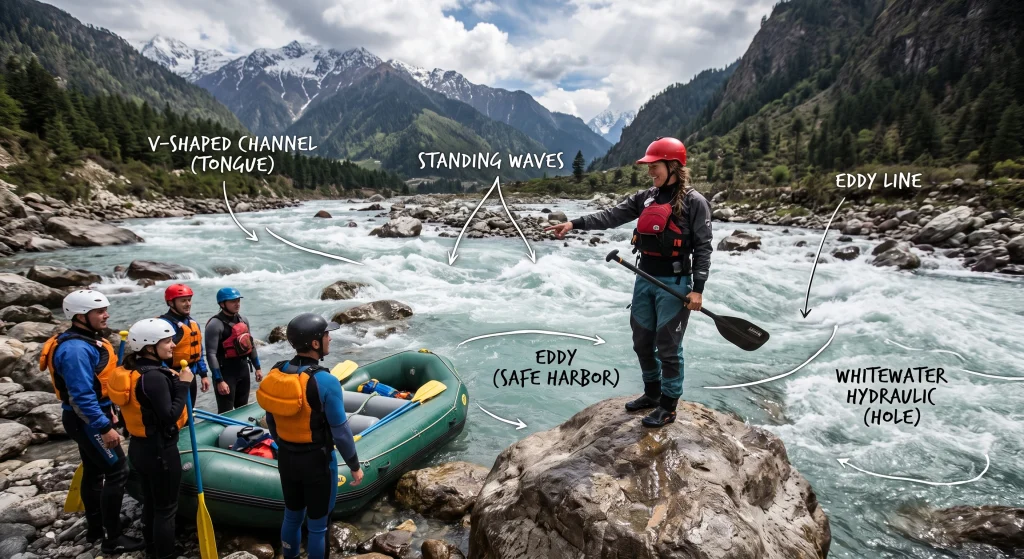
Table of Contents
To someone standing on a riverbank for the first time, whitewater often looks completely random.
Foaming water crashes over rocks, waves collide from different directions, and the entire river appears chaotic.
Professional river guides see something entirely different.
They don’t see chaos—they see patterns.
Every wave, current, eddy, and channel tells a story about what lies beneath the surface. Learning the basics of how to read rapids for whitewater rafting transforms uncertainty into understanding and helps explain why experienced guides confidently navigate rivers that seem impossible to cross.
Whether you’re planning your first rafting trip on the Ganges in Rishikesh or dreaming of tackling more technical rivers like the Zanskar or Barapole, understanding river hydrology makes every adventure more meaningful.
What Creates Whitewater?
Whitewater forms when flowing water encounters obstacles such as rocks, ledges, or sudden changes in river gradient.
As water is forced over, around, or between these obstacles, it accelerates and mixes with air, creating the familiar white, foaming appearance.
Several factors influence how challenging a rapid becomes:
[How to Read Whitewater Rapids]
- River gradient
- Water volume
- Rock formations
- Seasonal water levels
- River width
This combination creates each river’s unique personality.
Understanding Whitewater Rapid Classes
The internationally recognised whitewater rapid classes help paddlers understand river difficulty before entering the water.
Class I – Easy
Characteristics:
- Gentle current
- Small ripples
- Minimal obstacles
- Easy navigation
Ideal for:
- Families
- Children
- First-time rafters
Class II – Novice
Expect:
- Small waves
- Wide channels
- Straightforward routes
- Basic manoeuvring
Perfect for beginners looking for a little more excitement.
Class III – Intermediate
Features include:
- Larger waves
- Strong currents
- Technical steering
- Moderate obstacles
Many popular commercial rafting trips, including sections of the Ganges near Rishikesh, fall into this category.
Class IV – Advanced
These rapids demand:
- Powerful hydraulics
- Precise navigation
- Fast decision-making
- Experienced crews
Mistakes become far less forgiving.
Professional guides and skilled paddlers are essential.
Class V – Expert
Class V rivers represent the highest level of commercially runnable whitewater.
Expect:
- Massive drops
- Complex currents
- Narrow channels
- Powerful hydraulics
- Continuous technical manoeuvres
Only highly experienced teams with specialised equipment should attempt these rapids.
Reading the River Like a Guide
Professional river reading techniques begin with observation.
Before entering a rapid, guides stop and analyse the river.
They’re looking for specific features rather than simply following the fastest water.
The V-Shaped Channel
One of the easiest features to recognise is the downstream-facing “V.”
A clean V generally indicates:
- Deeper water
- Fewer rocks
- Safer passage
Many guides naturally steer toward this section.
Standing Waves
Standing waves remain fixed even though water flows through them.
Their size often indicates:
- Water speed
- River gradient
- Flow volume
Large standing waves create exciting rides but also require accurate boat positioning.
Eddies
Eddies form behind rocks or river bends where water circulates in the opposite direction.
Guides use eddies to:
- Rest
- Regroup
- Scout rapids
- Rescue swimmers
Think of them as calm parking spaces beside the main current.
Hydraulics and Recirculating Water
One feature every rafter should recognise is the hydraulic, sometimes called a “hole.”
This occurs when water pours over an obstacle and curls back toward itself.
Large hydraulics can trap boats or swimmers temporarily.
Professional guides understand:
- Which hydraulics are harmless
- Which should be avoided
- Which can be safely crossed using momentum
Reading these features is one reason guide training is so valuable.
River Reading Is About Planning Ahead
Experienced guides rarely react at the last second.
Instead, they plan several moves in advance.
Before entering a rapid they identify:
- Entry point
- Main current
- Obstacles
- Recovery zones
- Exit line
This forward planning allows smooth, controlled navigation even through fast-moving water.
Choosing the Right Rapid for Your Experience
Not every river is appropriate for every paddler.
General recommendations include:
Beginners
Choose:
- Class I
- Class II
- Easy Class III
These provide excitement while allowing plenty of instruction and confidence building.
Intermediate Rafters
Consider:
- Technical Class III
- Class IV under professional guidance
These rivers reward teamwork and good paddling technique.
Experienced Paddlers
Advanced rafters may enjoy:
- Class IV
- Class V
These rivers require excellent fitness, strong teamwork, and extensive river knowledge.
How to Raft Safely
Understanding rivers is only one part of safety.
Before every trip:
- Listen carefully during the safety briefing.
- Wear your helmet and life jacket correctly.
- Hold the paddle properly.
- Follow guide commands immediately.
- Never panic if you enter the water.
Professional outfitters train extensively for rescue situations, and every instruction is designed to keep the group safe.
Confidence comes from preparation—not guesswork.
Famous Indian Rivers for Whitewater Adventure
India offers rivers for every skill level.
Ganges – Rishikesh
Best for:
- Beginners
- Families
- Intermediate rafters
Known for scenic Himalayan valleys and exciting Class II–III sections.
Beas River – Kullu
A favourite for newcomers seeking fun rapids with spectacular mountain scenery.
Kundalika River – Kolad
Popular for controlled water releases that create reliable rafting conditions.
Barapole River – Coorg
Offers technical rapids during the monsoon season, attracting experienced rafters.
Zanskar River – Ladakh
One of India’s most demanding whitewater expeditions, combining remote wilderness with challenging rapids for experienced teams.
Final Thoughts
Professional river guides don’t rely on luck.
They rely on observation, experience, teamwork, and a deep understanding of how moving water behaves.
Learning the basics of how to read rapids for whitewater rafting won’t make you an expert overnight, but it will help you appreciate why rivers are carefully classified, why guides choose specific routes, and why every safety instruction matters.
Before planning your next adventure, explore “The Teamwork Test: Why Whitewater Rafting is the Ultimate Weekend Group Challenge” to discover why rafting is one of the best shared outdoor experiences, read “Splashes and Safety: What to Wear and What to Do If You Fall Out of the Raft” to prepare for common river situations, and browse Adhreline’s Marketplace Directory of Certified Whitewater Rafting Outfitters to compare professionally guided rafting trips across India’s most exciting rivers.
Every rapid tells a story.
With the right guide and a little knowledge, you’ll learn to read it with confidence rather than fear.
Frequently Asked Questions
What are the different whitewater rapid classes?
Whitewater rapids are graded from Class I (easy) to Class VI (extreme and generally not suitable for commercial rafting), helping paddlers understand river difficulty and required skill levels.
How do river guides choose the safest route?
Guides read water features such as V-shaped channels, eddies, standing waves, and hydraulics to identify the safest and most efficient path through each rapid.
Is Class III rafting suitable for beginners?
Many professionally guided Class III sections are suitable for healthy beginners after a thorough safety briefing, although confidence in moving water is helpful.
What is an eddy in whitewater rafting?
An eddy is a calm area of water behind an obstacle where the current reverses direction. Guides use eddies for resting, regrouping, and rescue operations.
Which Indian rivers are best for whitewater rafting?
Popular destinations include the Ganges in Rishikesh, the Beas in Kullu, the Kundalika in Kolad, the Barapole in Coorg, and the Zanskar in Ladakh, each offering different levels of rafting difficulty.